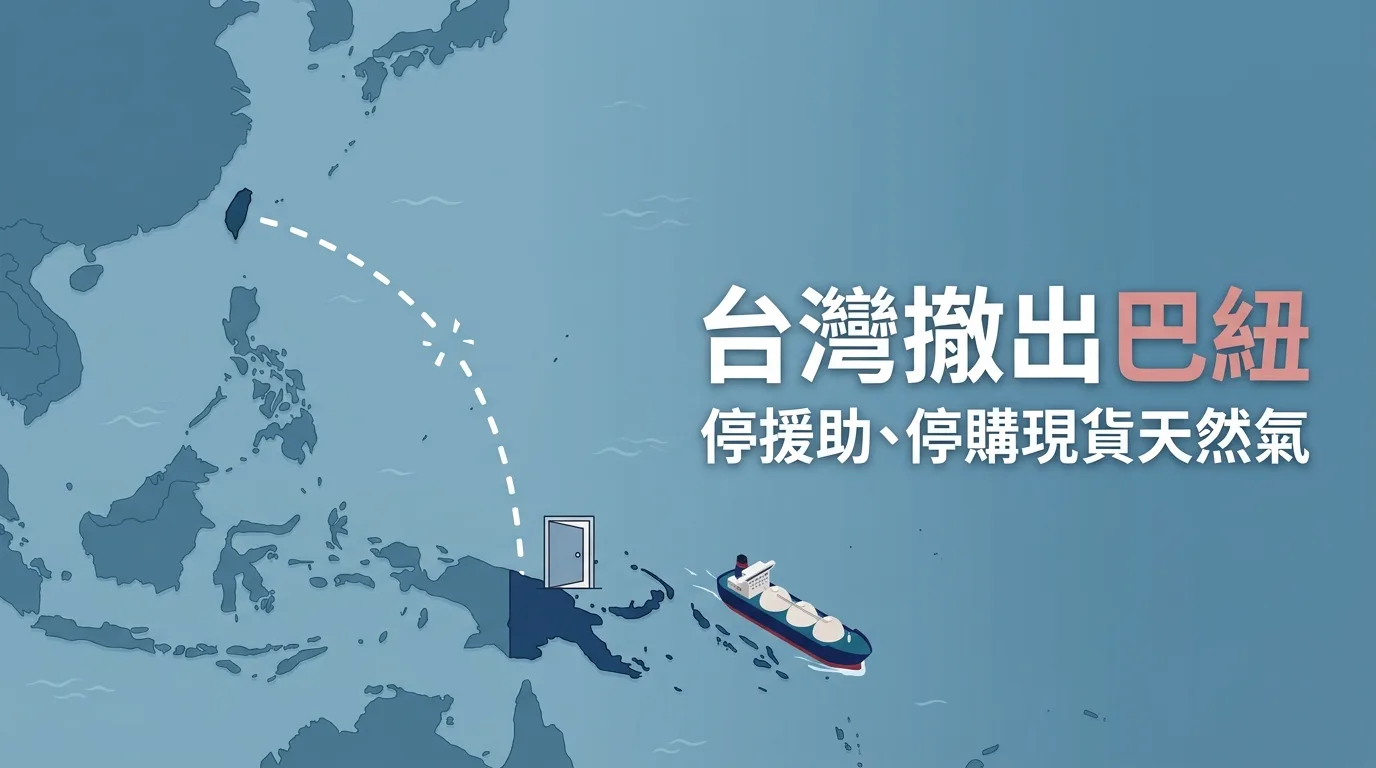
On the evening of November 6, the Ministry of Foreign Affairs announced that the government had decided to proactively close the representative office in Papua New Guinea, immediately withdraw all personnel, cease all office operations, and terminate all technical cooperation and assistance programs with Papua New Guinea. This stalemate, which began in mid-July when Papua New Guinea unilaterally announced the closure of Taiwan’s representative office, has dragged on for nearly four months.
Evacuate personnel, halt aid, and stop purchasing spot natural gas.
According to the China Times News Network , the Ministry of Foreign Affairs stated that the Papua New Guinea government recently unilaterally demanded that personnel of the Taiwan Economic and Trade Office in Port Moresby leave the country within a specified period and pushed for the closure of the office. The government made this decision after a comprehensive assessment, based on national dignity, diplomatic autonomy, and overall national interests. The terminated programs include technical missions, medical missions, scholarships, and talent development programs. The Ministry of Foreign Affairs stated that it will properly handle the follow-up matters of existing programs to ensure the safety and rights of relevant personnel.
Energy is the most significant aspect of this adjustment. According to the Central News Agency, the Ministry of Foreign Affairs stated that Taiwan has ceased purchasing Papua New Guinea liquefied natural gas (LNG) on the spot market and will not sign any new spot contracts. The planned purchase of approximately 500,000 metric tons in the first half of 2026 was originally scheduled. The Ministry of Foreign Affairs stated that Taiwan’s purchases account for about one-third of Papua New Guinea’s LNG exports, and that the country has completed supply and demand assessments, adjusted its procurement allocation, and found alternative gas sources, ensuring that gas supply will not be affected.
Several issues remain unanswered by the authorities. The Ministry of Foreign Affairs statement did not mention the specific departure deadline requested by Papua New Guinea or the number of personnel to be deployed. The statement also only addressed “spot” transactions; there has been no official statement regarding whether Taiwan’s existing long-term gas purchase contracts will be adjusted. Foreign Minister Lin Chia-lung stated in a July interview that Taiwan purchases over 1.2 million tons of natural gas from Papua New Guinea annually.
From the unilateral announcement in July to the deadline for leaving the country
In mid-July, Papua New Guinea’s Foreign Minister Justin Tkatchenko issued a statement announcing the immediate cessation of Taiwan’s operations in Papua New Guinea, citing adherence to the “One China Policy.” He further stated that, according to a resolution of the National Executive Committee, the entity of “Chinese Taipei” within Papua New Guinea was no longer recognized. According to the World Journal , the statement also mentioned that this year marks the 50th anniversary of the establishment of diplomatic relations between Papua New Guinea and China. Chinese Foreign Ministry spokesperson Lin Jian expressed “high appreciation” for this at the time.
Taiwan’s Ministry of Foreign Affairs responded at the time that it would not accept the unilateral decision, and that the representative office would continue to operate and negotiate through channels. A spokesperson for the U.S. State Department also expressed deep concern on July 17, seeing this as yet another example of Beijing pressuring Taiwan and its global supporters.
Papua New Guinea has a different story. According to a July report by the Liberty Times citing Australian media, Tkachenko stated that he had informed Australian Foreign Minister Penny Wong several weeks before the announcement, and that the closure of the office would not affect contracts between Taiwan’s CPC Corporation and Papua New Guinea’s gas exporters, and that trade between the two countries would continue.
The cooling of bilateral relations did not begin this year. Papua New Guinea closed its trade office in Taiwan in 2023, replacing it with a downgraded agency; the two countries briefly established diplomatic relations in the late 1990s. Scholar Huang Kuei-po, in an interview with the United Daily News in July, analyzed that the establishment of such offices is usually based on the principle of reciprocity, and Papua New Guinea clearly considered its economic and trade relations with Taiwan not so important, therefore not seeing a need for reciprocity.
Diplomatic resources are being diverted to the Cebu office in preparation for its opening.
In its press release, the Ministry of Foreign Affairs emphasized that this was a proactive diplomatic decision made by Taiwan, and that diplomatic resources must be allocated according to overall planning and actual effectiveness. Future resources will be invested in friendly nations and other regions with potential for cooperation. The Ministry also reiterated that China continues to use political pressure and economic influence to interfere in other countries’ diplomatic decisions and shrink Taiwan’s international space, and that all countries should have the right to independently decide how to interact with Taiwan.
Based on the information already released, Taipei’s simultaneous announcement of withdrawing its embassy, halting aid, and suspending spot energy purchases is tantamount to using trade and aid as leverage in response to Papua New Guinea’s request to leave the country, and controlling the pace of the process through a “proactive closure.” The actual impact on Papua New Guinea will depend on the fate of the long-term natural gas contracts and how the Papua New Guinean government responds subsequently.
According to Storm Media, as the Ministry of Foreign Affairs announced its withdrawal from Papua New Guinea, Taiwan’s second overseas representative office in the Philippines, the Cebu Office, was preparing to open.
Sources: China Times News Network, Central News Agency, World Journal, Liberty Times, Storm Media, United Daily News.